We occasionally share updates when important information changes or new long-form guides are published. Just practical updates related to long-term living in Surat Thani and Southern Thailand.
Surat Thani occupies a unique position in the socioeconomic landscape of Southern Thailand. While often perceived by transient travelers as a mere logistics node for accessing the islands of Koh Samui, Koh Phangan, and Koh Tao, the city serves as a critical administrative and commercial capital.
For those seeking the best areas to live in surat thani, the province offers a level of stability and economic predictability that is frequently absent in more tourism dependent regions like Phuket or Pattaya.
The housing market here is grounded in the domestic Thai economy, specifically the rubber, coconut, and palm oil industries, which ensures that rental rates and property values remain insulated from the high volatility of international tourism cycles.
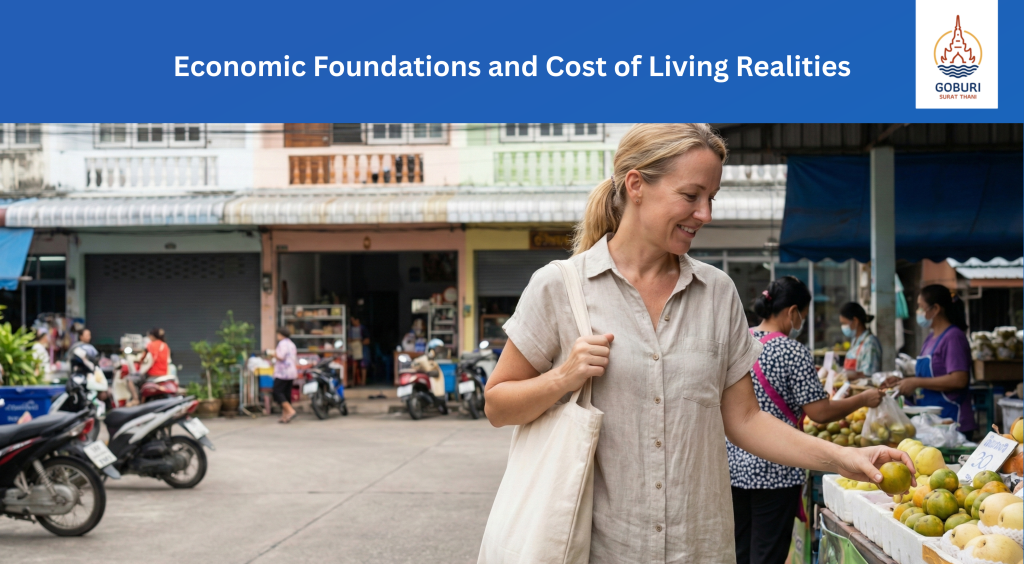
Economic Foundations and Cost of Living Realities
The cost of living in Surat Thani is significantly lower than in Bangkok or the neighboring island provinces. This financial advantage is a primary driver for families and digital nomads who prioritize capital preservation and long term sustainability.
This economic stability provides a predictable environment for those managing remote work incomes or fixed retirement funds. Unlike the hyper competitive vacation rental markets, Surat Thani housing on the mainland is primarily built for long term residency, which shifts the power back to the tenant and allows for more favorable lease terms.
Neighborhood Analysis: The Talat District and Historical Core
The sub-district of Talat constitutes the historical and cultural heart of the city. Located at the mouth of the Tapi River, this area was historically known as Ban Don, a name that translates to “village on high ground”.
This district is the most walkable part of the city and is characterized by a high density of traditional shophouses, where families have operated businesses on the ground floor while living on the upper levels for generations.
Cultural Immersion and Urban Life
The neighborhoods in Surat Thani found within Talat Lang and the Na Dan Community offer a glimpse into the Sino-Portuguese architectural past of the region. This area is ideal for residents who value cultural discovery over modern seclusion.
The proximity to the San Chao Night Market and the Bandon Pier provides immediate access to the city’s most vibrant culinary and social scenes.
Living in the urban core means accepting a higher level of noise and congestion. The housing inventory here consists primarily of older townhouses and high rise condominiums.
While these units lack the expansive gardens found in the suburbs, they offer the highest level of convenience for those who do not wish to rely heavily on long distance commuting. The presence of street art in the narrow alleys further enhances the creative fuel that many remote workers find essential for their productivity.
Logistics and Connectivity in the Core
The Talat district serves as a central hub for the local songthaew network, making it one of the few areas where private vehicle ownership is not strictly mandatory for short trips.
However, the city is not designed for pedestrians, and the humidity often makes even short walks exhausting. Residents in this zone benefit from the proximity to government offices and the Bandon International Private Hospital, which caters to the immediate healthcare needs of the urban population.
Makham Tia: The Suburban Standard for Families
As the city has expanded, Makham Tia has emerged as the premier residential zone for middle and upper class families. This sub-district represents the modern standard for Mueang Surat Thani real estate, defined by the proliferation of “Mubans” or gated communities. These estates offer a level of security and communal space that is difficult to find in the city center.
The Muban Lifestyle and Security
For families, the gated community remains the gold standard of Surat Thani housing. These developments typically include 24 hour security, shared parks, and playgrounds.
A typical detached three bedroom house in a well maintained estate in Makham Tia ranges between 18000 and 25000 THB per month. These homes are designed for long term residency and often include private parking for two vehicles and a small perimeter garden.
The lifestyle in Makham Tia is significantly quieter than in Talat. It provides a peaceful retreat from the city while remaining only a ten to fifteen minute drive from major shopping centers and healthcare facilities.
Infrastructure and Health in Makham Tia
The presence of the Surat Thani Hospital, which opened in 1953 and now boasts over 800 beds, makes Makham Tia a critical node for healthcare access. The sub-district also benefits from excellent transport links, as it is situated next to the main highway into the city.
For those considering the trade offs between urban convenience and suburban space, the choice of houses versus condos often leads to Makham Tia for the superior square footage and environmental quality.
Feature
Makham Tia
Talat (City Center)
Housing Type
Detached Houses / Gated Estates
Townhouses / Condos
Environment
Quiet, Green, Suburban
Vibrant, Noisy, Urban
Security
Gated with 24/7 Guards
Individual Street Level
Walkability
Low (Car/Motorbike needed)
High (Market access)
Healthcare
Regional Hospital Proximity
Private Clinics
Wat Pradu: The Retail and Commercial Corridor
Located on the new economic road that links the city with the airport, Wat Pradu development is the fastest growing commercial area in the province. This sub-district is anchored by the Central Plaza Surat Thani, a massive retail project that serves as the trade center of the upper south.
Modern Amenities and Lifestyle Convenience
The development of Wat Pradu has fundamentally changed the best areas to live in surat thani for those who prioritize modern amenities.
Central Plaza alone features over 250 retail shops, cinemas, and professional service centers. This has attracted a wave of new Mueang Surat Thani real estate projects, including modern condominiums and contemporary loft style housing estates.
Residents in Wat Pradu enjoy the highest level of convenience regarding shopping and dining. The area is also home to several high end hotels like the B2 Surat Thani Premier and the S Tara Grand, which reflect the professional nature of the sub-district.
For digital nomads and young professionals, Wat Pradu offers a lifestyle that is closest to that of a major metropolitan area while maintaining the lower costs of the province.
Strategic Mobility in Wat Pradu
The location of Wat Pradu is strategically advantageous for those who travel frequently. It is situated on the primary route to the Surat Thani International Airport, and its proximity to major bypass roads allows for easy travel to neighboring provinces.
However, this convenience comes with a reliance on private transportation. The decentralized nature of modern housing estates in this area makes a car or motorbike a non-negotiable requirement for daily life.
Bang Kung: Riverside Living and Emerging Markets
To the east of the city core lies Bang Kung riverside, a sub-district that offers a unique quality of life defined by the Tapi and Thathong Rivers. This area is traditionally known for its seafood markets and its role in the local maritime economy.
Waterfront Property and Microclimates
The neighborhoods in Surat Thani along the river often offer larger plots of land and a cooler microclimate due to the proximity of the water and natural vegetation. This makes Bang Kung a popular choice for families who prioritize outdoor space and greenery.
The sub-district is currently seeing a surge in development, with former agricultural lands being converted into premium residential estates.
The architecture in Bang Kung often reflects the transition from rural to urban. You will find traditional wooden houses alongside modern detached villas with river views.
For residents, this area provides a serene environment that is still within a short commute of the city center. However, being a resident in a riverside community requires a clinical approach to managing property according to local climate realities, specifically seasonal water levels.
Economic Growth in Bang Kung
The Thathong River marks the boundary between the Mueang district and Kanchanadit, making Bang Kung a strategic bridge between urban and rural southern Thailand.
The area is home to the Sahathai Garden Plaza and the Thaksin Hospital, ensuring that residents do not have to sacrifice modern services for a riverside lifestyle. This mix of nature and infrastructure makes it one of the most promising areas for long term property investment.
Khun Thale: The Intersection of Education and Nature
The sub-district of Khun Thale is centered around a small lake and serves as the educational heart of the province. It is home to the Suratthani Rajabhat University (SRU), which has evolved from a teacher’s college into a prototype university for the southern region.
The Educational Environment
For families and academics, Khun Thale offers a unique atmosphere. The presence of a large student population supports a diverse array of affordable cafes, markets, and recreational facilities. The lake itself provides a rare green space for the city, attracting residents for jogging, exercise, and social gatherings.
The Surat Thani housing market in Khun Thale is diverse, ranging from low cost student apartments to modern housing projects like Supasiri Futertown, which was completed in 2018. This sub-district is ideal for those who want to be part of an active, education focused community while remaining close to nature.
Environmental Resilience and the Lake
Khun Thale is also a focus area for the city’s urban resilience projects. As a natural water retention area, the lake plays a critical role in the city’s flood management strategy. Residents in this area benefit from the government’s commitment to maintaining the ecosystem, which ensures that the neighborhood remains a livable and sustainable part of the city.
Phunphin: The Logistics Node and Affordable Living
While Phunphin is a separate district, it is functionally integrated into the life of the provincial capital. It is home to the Surat Thani Railway Station, which is located approximately 15 kilometers from the city center.
Transit-Oriented Development
Living in Phunphin offers a distinct advantage for those who rely on rail travel to Bangkok or Malaysia. The district has a charming, friendly atmosphere and serves as a gateway to breathtaking landscapes like the Khao Sok National Park. The Surat Thani housing market in Phunphin is generally more affordable than in the Mueang district, making it a viable option for those on a stricter budget.
The Challenge of Commuting
The primary drawback of residing in Phunphin is the distance from the city center. The commute can take between 20 and 50 minutes depending on the mode of transport and traffic conditions. While there is a cheap orange bus service that connects the station to the city, most residents find that private transportation is essential for a functional daily routine.
Location
Distance to City Center
Primary Feature
Talat
0 km
Historical Core / Markets
Makham Tia
2 to 5 km
Gated Estates / Hospitals
Wat Pradu
5 to 7 km
Retail / Modern Projects
Bang Kung
4 to 8 km
Riverside / Emerging Market
Phunphin
15 km
Rail Logistics / Affordability
Education as a Decision-Support Factor
For international families, the availability of quality education is often the primary driver for choosing the best areas to live in surat thani. Surat Thani has seen a significant improvement in its educational infrastructure, moving away from purely local schools to high capacity international institutions.
International Schooling Options
Daniel International School (DIS) is a prominent institution located in the Kanchanadit district but serving the broader Mueang area. It follows an American style curriculum and serves children from nursery through grade 9, with plans to expand through high school. The school provides essential support for expat families, including documentation for education visas and guardian visas.
For parents, the choice between these institutions often dictates their residential location, with many choosing to live in Makham Tia or Bang Kung to minimize school run times.
Higher Education and Research
The presence of Suratthani Rajabhat University and the Faculty of Medicine from Prince of Songkla University ensures that the city has a high level of intellectual and professional capital. This academic environment contributes to the overall stability and growth of the region, making it an attractive place for long term residency.
Healthcare and Medical Infrastructure
Surat Thani is a regional medical hub, offering a level of care that is comparable to major cities in Thailand. This is a critical factor for families and retirees considering a permanent move. The province hosts a mix of large public regional hospitals and specialized private facilities.
Regional and Private Facilities
The Surat Thani Hospital is a Ministry of Public Health regional hospital that serves as a teaching hospital for multiple universities. For more immediate or western oriented care, residents often turn to Thaksin Hospital or the Srivichai Hospital in Makham Tia.
These facilities are equipped with modern medical technology and often have English speaking staff to assist international patients.
For residents on the islands of Koh Samui or Koh Phangan, the mainland hospitals in Surat Thani are the primary destination for serious medical issues, as they offer higher capacity and more specialized equipment than the smaller island clinics. This makes living on the mainland a strategic choice for those who want the best possible access to healthcare.
Infrastructure and Digital Connectivity
The digital infrastructure in Surat Thani is professional grade, catering to the needs of modern remote workers and digital nomads. Fiber internet is ubiquitous in all modern neighborhoods in Surat Thani, with providers offering stable connections at competitive prices.
Connectivity and Fiber Internet
In 2026, government rate electricity and fiber internet remain stable drivers of the cost of living in Surat Thani. A standard residential internet package costs between 599 and 1200 THB per month, providing speeds sufficient for high definition video conferencing and large data transfers. For digital nomads, this ensures that the city is a viable alternative to more expensive hubs like Bangkok.
Public Transport and Private Mobility
While the city is walkable in small pockets like the Talat district, the sprawling nature of the provincial capital makes private transportation a necessity. The most rational way to navigate the city is by motorbike, which offers maximum cost control and efficiency. For families, a car is considered essential for safety and comfort, particularly during the monsoon season.
Environmental Realities and Resilience
Understanding the climate is essential for anyone considering Surat Thani housing. The region enjoys a tropical climate with three distinct seasons, consisting of winter from November to February, summer from March to May, and the monsoon season from June to October.
Air Quality and the Sponge City Concept
One of the significant advantages of living in Surat Thani is the superior air quality compared to Bangkok or Chiang Mai.
While major northern cities often struggle with seasonal burning seasons and high PM2.5 levels, Surat Thani consistently maintains good to moderate air quality. This makes it a healthier environment for children and the elderly.
The city is also part of a five year Urban Resilience project launched in 2024, which focuses on nature based solutions to manage flood risks. This includes the Sponge City concept, aimed at restoring natural water cycles through the integration of green and blue infrastructure.
Residents should investigate the common rental problems associated with seasonal drainage before signing long term leases in low lying areas.
City
Typical AQI (March)
Environmental Feature
Surat Thani
86
Coastal Breezes / Peat Swamps
Bangkok
164
Urban Heat / High Density
Chiang Mai
176
Seasonal Burning / Valley Trap
Cultural Integration and Social Norms
Relocating to a provincial city like Surat Thani involves a steeper learning curve than moving to an international hub. The language barrier is more significant, as English is less widely spoken in local markets than on the tourist heavy islands.
Social Integration for Long-Term Residents
The expat community in the city is smaller and consists primarily of serious long term residents rather than transient tourists. Socializing often occurs in local cafes or during traditional festivals like the Chak Phra Festival or the Loy Krathong celebration on the Tapi River.
Respecting local etiquette is paramount for a successful transition. This place great importance on the Wai greeting and being cool headed in public.
Learning basic Thai phrases such as Sawatdee for hello and Khop Khun for thank you goes a long way in earning smiles and building relationships within the community. For more insights on adjusting to the local culture, see our guide on renting as a foreigner.
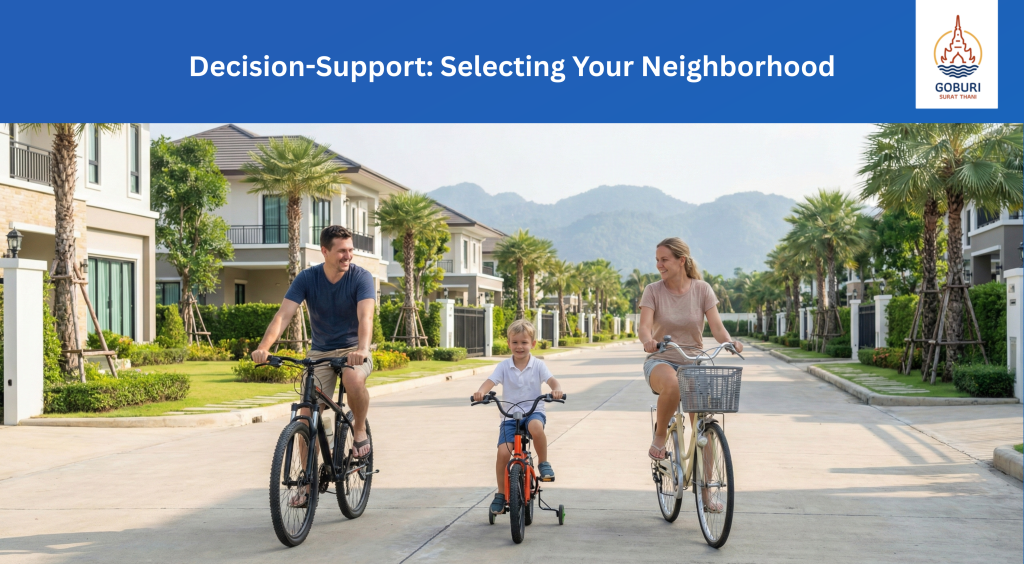
Decision-Support: Selecting Your Neighborhood
The choice of neighborhood in Surat Thani should be dictated by your specific lifestyle priorities and professional requirements. Each sub-district offers a distinct set of advantages and trade offs.
For Families Prioritizing Security and Schools
Makham Tia remains the primary recommendation for families. The combination of gated communities, proximity to the regional hospital, and easy access to international schools like DIS makes it the most stable and convenient choice for long term residency. The availability of large detached houses provides the space necessary for children to grow in a safe environment.
For Digital Nomads Seeking Culture and Affordability
The Talat district offers the middle ground lifestyle that many digital nomads seek. It provides an authentic Thai experience with immediate access to markets and the river, while maintaining the low overhead costs necessary for sustainable remote work. The creative stimulation of the old town’s street art and coffee culture makes it a superior choice for those who value cultural discovery.
For Professionals Requiring Modern Convenience
Wat Pradu is the ideal choice for those who want to be at the center of the city’s commercial growth. The proximity to Central Plaza and the primary route to the airport makes it the most modern and convenient sub-district for active professionals. The housing projects here are the newest in the province, offering contemporary designs and modern amenities.
For Those Seeking a Connection with Nature
Bang Kung and Khun Thale offer a more tranquil lifestyle for those who wish to avoid the noise of the city. The riverside views in Bang Kung and the lakeside atmosphere of Khun Thale provide a unique quality of life that prioritizes environmental well being. These areas are perfect for residents who value outdoor activities and a cooler, more natural microclimate.
Navigating the Rental Market
Regardless of the area you choose, the process of securing Surat Thani housing should be approached with clinical precision. Unlike the volatile island markets, mainland landlords often prioritize long term stability over high turnover. This allows for more predictable lease terms, but it also requires the tenant to demonstrate a commitment to the community.
Long-Term vs. Short-Term Considerations
While hotels and guesthouses in the city center like the CBD Hotel or Blu Monkey are convenient for short stays, they do not provide the structural realities needed for residency.
Transitioning to a long term rental involves understanding the nuances of Thai lease agreements and ensuring that utilities like electricity are billed at the government rate.
Residents should also be aware of the shophouse heritage of the city. While these buildings are culturally significant, they may not offer the modern insulation or noise cancellation found in purpose built residential estates. Evaluating the trade offs between historical charm and modern comfort is a key part of the decision making process.
The Resilience of Surat Thani
Surat Thani is a city that rewards those who look beyond the surface. It is not a paradise designed for consumption but a working city designed for life. The best areas to live in surat thani are those that offer a balance between the traditions of the past and the infrastructure of the future.
The 2030 development plans, the commitment to climate resilience through the Sponge City concept, and the robust healthcare and educational systems all point toward a city that is preparing for long term prosperity. For families, professionals, and remote workers, the province offers a stable foundation upon which to build a sustainable life in Southern Thailand.